History
동래(Dongnae) was once the center of 부산(Busan)
강동일(Gang Dong-il)3 min read
Today, 부산(Busan) brings to mind 자갈치시장(Jagalchi Sijang), 해운대(Haeundae), 남포동(Nampodong) and 서면(Seomyeon). Yet its name has represented the whole region only relatively recently. Before August 1910, the larger administrative name was 동래(Dongnae). Busan was merely one of several ports within Dongnae-bu. Contrary to today's familiar hierarchy, Dongnae was the name governing Busan.
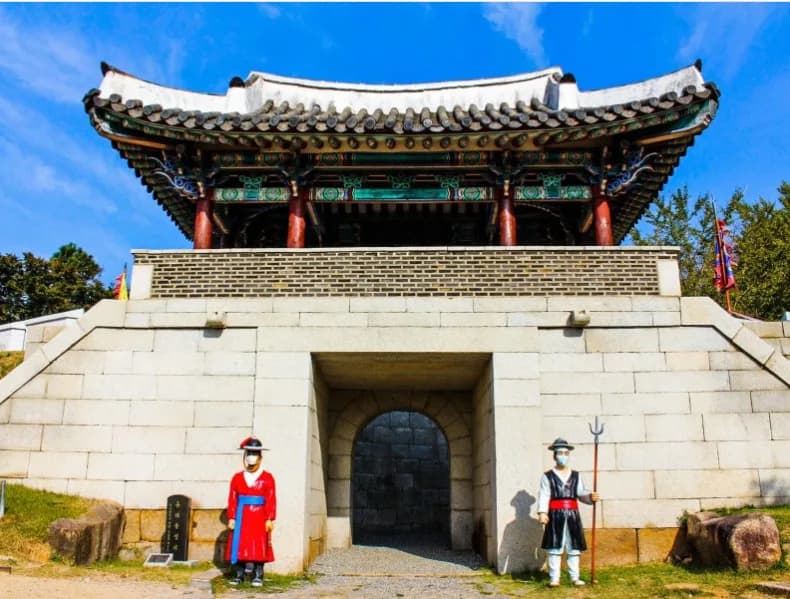
Dongnae's history stretches back more than two thousand years. Known as Jangsan-guk or Geochilsan-guk during the Samhan era, the area became Dongnae-gun in 757, after Silla unified the Three Kingdoms. It later continued as Dongnae-hyeon and Dongnae-dohobu under Goryeo and Joseon. The Joseon magistrate held a position comparable to today's mayor of Busan and worked in the administrative hall inside 동래읍성(Dongnae Eupseong). The fortress enclosed government offices and a Confucian school, making it an administrative and cultural center as well as a defense. If 의주(Uiju) was Joseon's northern gateway, Dongnae was its southern one. Facing Japan across the Korea Strait gave the town particular importance for national security.
That importance emerged most dramatically in the Japanese invasions of 1592. On April 15, Japanese troops surrounded the fortress. Magistrate 송상현(Song Sang-hyeon) resolved to share his people's fate and shut the gates. When 고니시 유키나가(Konishi Yukinaga) urged, "Fight if you wish, or let us pass if you do not," Song replied, "It is easy to die, but difficult to let you pass." After just over two hours of fierce resistance, the fortress fell. Song and many soldiers and civilians died. The battle painfully demonstrated that Dongnae was a frontline gateway to the country, far more than a provincial town.
After the war, Dongnae remained a channel for diplomacy with Japan. By the late Joseon period, it was also famous for its hot springs. Its long-standing administrative and cultural role fostered deep roots in aristocratic and Confucian culture, helping sustain traditional arts such as the masked dance 동래야류(Dongnae Yaryu), 동래한량춤(Dongnae Hallyangchum) and 동래학춤(Dongnae Hakchum). At the first full moon of each lunar year, the eastern and western teams reportedly held a tug-of-war lasting several days and drawing more than ten thousand people. That scale alone suggests the town's power to bring people together.
Things began changing after the port opened in 1876. Japanese settlements developed around Busanpo and 초량(Choryang); expanding trade gradually moved the city's center of gravity toward the coast. The decisive shift came in 1910, when the colonial authorities reorganized Dongnae-bu as Busan-bu, reversing their former hierarchy. They also sought to erase Dongnae's symbols, moving 망미루(Mangmiru) from the administrative hall at the fortress to the entrance of 금강공원(Geumgang Gongwon). In 1938, they forcibly halted the tug-of-war, fearing that large gatherings might fuel anti-Japanese sentiment.
Much of the fortress was demolished during colonial rule and later urban development. Yet there is a story behind the district office's continued proximity to its old site. Older residents long held that government offices should not move beyond the fortress walls. Several proposed relocations reportedly fell through because the sites were outside that boundary. The relics still uncovered underground also remind us that people lived densely here for centuries.
After liberation, Dongnae returned as a district when the district system began in 1957. It included today's Suyeong, Haeundae, Geumjeong and Yeonje districts, accounting for 46 percent of Busan's area, almost half. In the 1960s and 70s, its hot springs, the beaches of Haeundae and 광안리(Gwangalli), 금정산(Geumjeongsan) and 범어사(Beomeosa) made it a celebrated honeymoon and sightseeing destination. Divided into several districts today, it may seem to have lost its former stature, but its name still holds roots that have sustained the city for two thousand years. Behind the dazzling coastal skyline, the question of where Busan truly began always leads back to Dongnae.
#동래(Dongnae)#동래시장(Dongnae Sijang)#동래읍성(Dongnae Eupseong)