History
센텀시티(Senteom Siti) in 부산(Busan): the story of 부산비행장(Busan Bihaengjang)
강동일(Gang Dong-il)3 min read
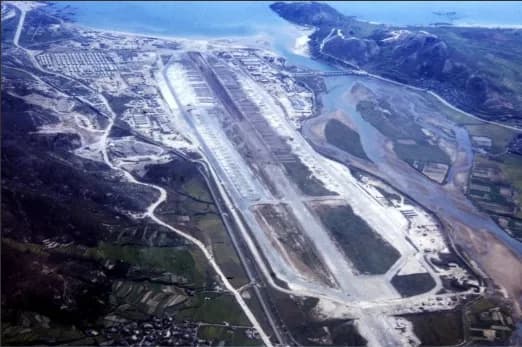
Walking among the skyscrapers of 센텀시티(Senteom Siti) in 해운대(Haeundae), it is hard to imagine a runway where planes once landed and took off. Near the outdoor stage in 나루공원(Naru Gongwon), a small stone marker reads "The History of Subi." It quietly recalls that only a few decades ago, the land beneath today's towers was an airport with a runway and control tower.
The story begins during Japanese colonial rule. In 1940, the authorities forced residents to build a military airfield here. Sediment carried by the 수영강(Suyeonggang) and 온천천(Oncheoncheon) had accumulated over many years into a broad, flat plain ideal for an airfield. After liberation, it became 수영비행장(Suyeong Bihaengjang). In October 1948, Korea's first civilian air service began here, connecting 부산(Busan) and Seoul. With roads and railways still limited, a corner of Busan became a gateway to the sky.
Hard as it is to picture now, propeller passenger planes once used this runway. Nearby residents reportedly watched them through their windows as part of everyday life. An airport amid today's city illustrates the geography of a time when broad, undeveloped plains were still common here.
The airfield grew more important during the Korean War. As supplies and troops flowed to the temporary capital, it became the UN forces' K-9 air base and a vital transport hub. In a war-devastated country, every transport plane was a lifeline. In 1958, its name changed to Busan (Suyeong) Airfield; on September 30, 1963, it was elevated to Korea's first formally designated international airport. Before 김해국제공항(Gimhae Gukje Gonghang), this was where local people first encountered a gateway to air travel. Up to 1958, Suyeong Airfield was its name; after 1958 the official name was 부산비행장(Busan Bihaengjang), and from 1963, 부산국제공항(Busan Gukje Gonghang). Residents nevertheless continued calling and remembering it as Suyeong Airfield. That memory survives in the name 수비삼거리(Subi Samgeori) in the Centum area.
As the city grew, an airport in the middle of its built-up area faced increasing limitations. In 1973, civilian aviation moved to Gimhae Gukje Gonghang. The former airfield remained in military use for a time, with runways and hangars under Army Headquarters. A large central tract thus stayed tied to aviation for years. In April 1996, a national-property sale agreement between Busan Metropolitan City and Army Headquarters finally returned the land to the city.
The site then took on a completely new appearance. The international exhibition and convention center 벡스코(Bekseuko) rose on the former runway, surrounded by high-rise apartments, department stores, broadcasters and advanced office facilities. Centum City took shape. Towers replaced aircraft, and building lights shone where the control tower once watched the sky. The name Centum comes from Latin for one hundred, expressing the ambition for a high-tech new city that was 100 percent complete. With development largely finished in June 2013, it became a major international business district and a center for meetings, incentives, conventions and exhibitions.
From forced colonial labor through wartime transport, from the country's first international airport to a forest of towers, this site's history compresses the city's growth. Residents compelled to prepare the runway, refugees enduring the roar of transport planes and planners building today's skyscrapers all passed over the same ground in different eras. Few walking Centum City's avenues today know it was once a runway. A pause beside the small marker in Naru Gongwon reveals how many layers of history lie beneath their feet.
#부산수영비행장(Busan Suyeong Bihaengjang)#센텀(Senteom)